Featured post

How do they compare? A close look at TED-ED Lessons, EDpuzzle,and Playposit (fka EduCanon).

Students love videos. Teachers love videos.  We ALL love videos.  And, for many of us, we learn so much better if we can see  what we ne...

Tuesday, 22 March 2016

What is a human? (And why does this question matter?)

If we are to believe those in the "know", humans around the world are about to experience the most profound societal upheaval; the most profound redefining of our purpose and point of existence not in the near future, but now.  

Artificial intelligence and the increasing sophistication of robotics will, according to Ray Kurzweil, the director of Google, a man whose predictions about the future seem to come true with consistent frequency, believes that by 2045, AI will increase the "human biological machine intelligence a billion-fold by 2045."  ( "Ray Kurzweil: As Humans and Computers Merge ..." 2014. 22 Mar. 2016 <https://www.singularityweblog.com/ray-kurzweil-pbs-immortality/>).

Monday, 21 March 2016

Let's Provide LD Students With What They Need


In my second year of teaching in an  impoverished rural community, I had a young man in my Grade 10 Language Arts class that was profoundly dyslexic. He was a great kid, personable and kind, but his reading level despite much remediation had plateaued, and, frankly, his writing wasn't much stronger. This was nearly 20 years ago. Assistive technologies like Dragon NaturallySpeaking and text-to-speech programs like  Read and Write for Google Chrome or speech- -to-text programs like Google Voice Typing, were pretty much still in the realm of science fiction or prohibitively expensive.  If you wanted to provide an audio copy of a book, it literally came as a case of 10 cassette tapes and you had to order it through the public library. Often, I would simply resort to reading everything out loud to his entire class.

There didn't seem to be much by way of accommodations back then, but, necessity is the mother of invention and I began to find ways to help out this young man. I began to record all of my lectures as this student couldn't read my lecture notes.  I recorded every text we read in class. And, whenever possible I would let him respond orally or I would scribe for him.  He still found ELA class difficult, but he passed ELA 10 and, with continued accommodations, went on to graduate.

The accommodations I provided him most definitely enabled this young man to reach his potential and learn, but there was a benefit I hadn't considered.

When this young man wasn't using the recorded books or my lecture tapes, my other students were. I no longer needed to "re-teach" a lesson to a student who was away.  I could just hand them that class' tape,  they could take it home, and they could listen and learn. Students also began to borrow the textbook tapes I'd made. They talked about how, if they could listen and follow along, they understood what they were reading better.
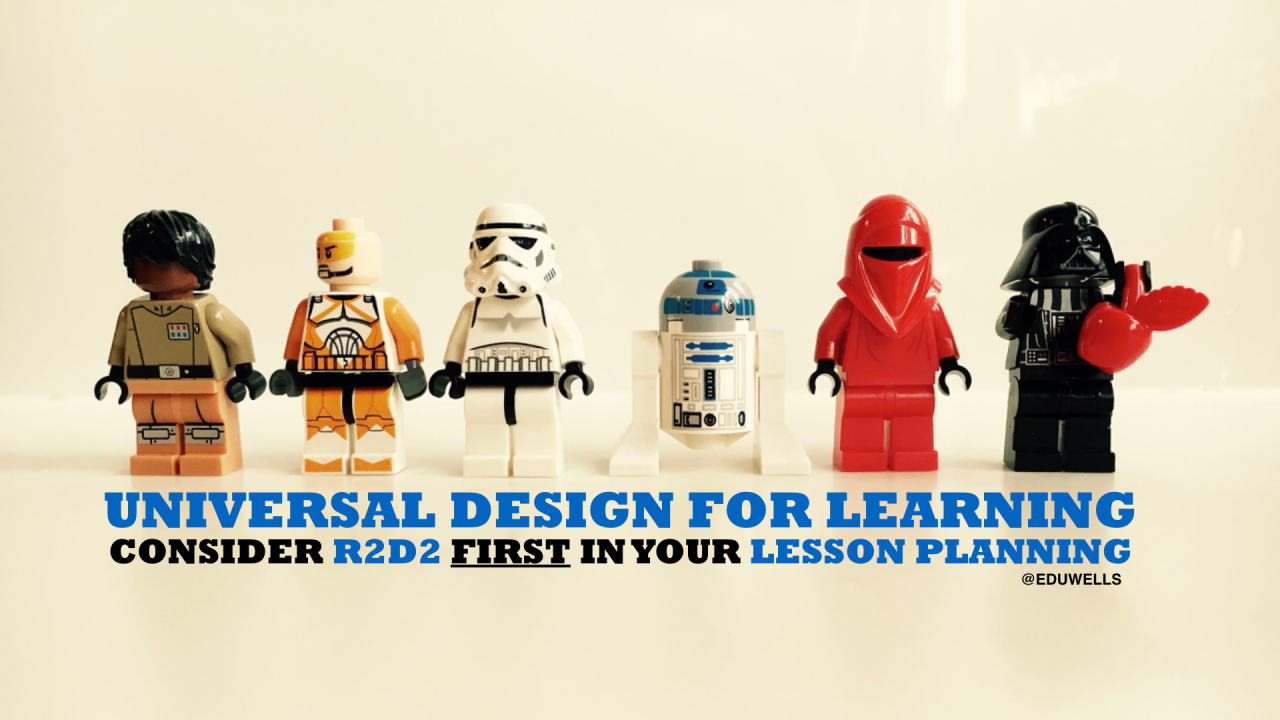
http://eduwells.com/2016/01/04/star-wars-posters-for-educators/

The accommodations I was making for that one student, were, in actuality, benefitting ALL of my students. Of course this is hardly rocket science, and now, in an era of personalization and differentiation, such accommodations of a child's individual learning needs seems almost archaic.

But, are they really?

Fast forward to today.  I now work in a school in which every student has a diagnosed learning disability, an Individualized Program Plan, and a number of mandated accommodations that they must have. Yet, I still have conversations every week it seems with some of my parents, and with many of my students, who see the use of accommodations as a crutch or as something to be ashamed of.

Seriously! No one questions the accommodation of eyeglasses one must wear in order to see. No one questions a paraplegics' need for a wheelchair.  And no one asks the athlete with a prosthetic leg to take it off during the 100 meter dash as it is a "crutch".

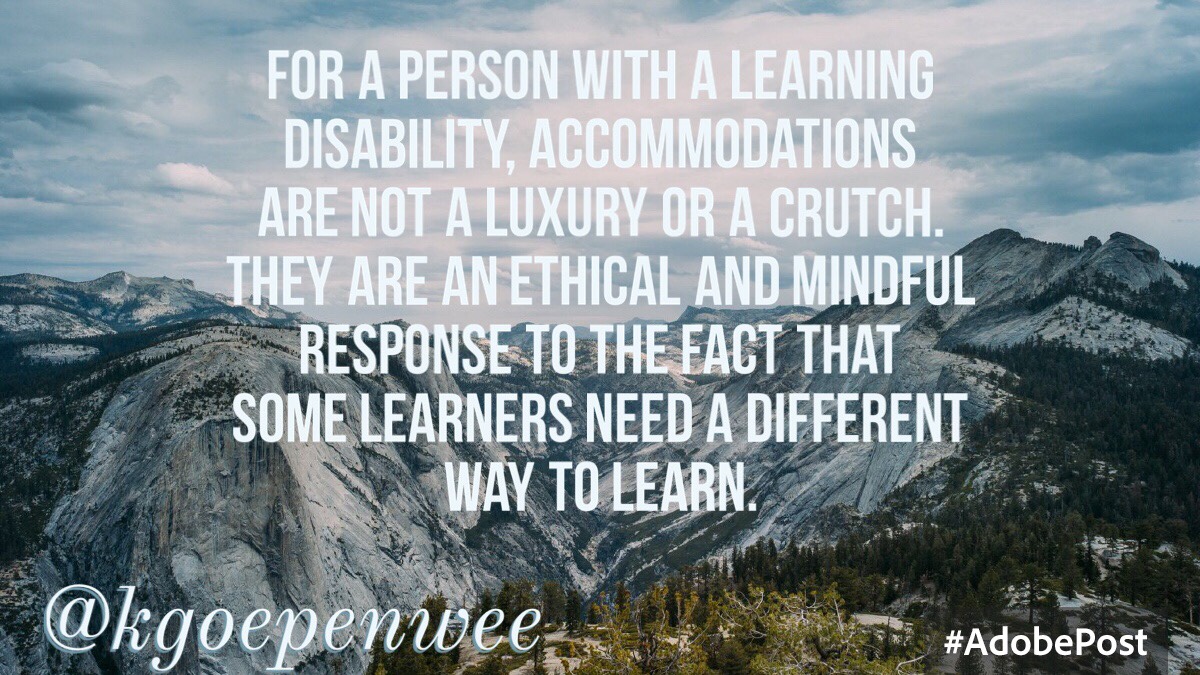
For a person with a learning disability, the necessity of an audio version of a unit exam, the need to use a word processor to write an essay, or the use of a standing desk so as to be able to better manage their hyperactivity, is not a luxury or a crutch.  It is simply an ethical and mindful response to the fact that some learners need a different way to learn. And, for some learners, that difference is as profoundly challenging as it would be for a myopic person to drive without glasses or physically disabled person to perform some physical tasks without help.

To this end, I have written a TED-Ed Lesson on accommodations, differentiation and the need for parents and educators to help students learn how to advocate for what they need in order to learn.  I hope that you find it useful.

"I Know What I Need: Accommodations, Differentiation, and Self-Advocacy

Together, let's remove the stigma that still exists surrounding learning disabilities and neurodivergence. Let's revision our practice so ALL students can maximize their potential and enjoy the right to learn.


Monday, 7 March 2016

10 Reasons Why Students Love TED-Ed Clubs

TED-Ed Clubs logoThis post is inspired and co-authored by two members of the Rundle Academy TED-Ed Club. Charlotte and Cameron both have made the committment to pursue and support ideas worth sharing in two ways: Charlotte, as a student working on a talk, and Cameron, as a member of the TED-Ed Club leadership cohort. 
I found their ideas to be a touching and enlightening look into why the Rundle Academy TED-Ed Club has become a popular extracurricular activity that attracts a wide range of students with a wide range of interests. In fact, it seems that the TED-Ed Club program has a little something for everyone.  So, what are Charlotte and Cameron's top reasons for being in a TED-Ed Club?  Here they are:

  1. People can share their voice and they don’t need to filter their ideas through other people.
  2. It’s a great way for kids to express their ideas.
  3. It’s a calm, nurturing environment.
  4. It can give you the motive to do things that change the world.
  5. There are no rules regarding what you can or can’t write.
  6. It gives you the opportunity to be in the spotlight.
  7. You get to meet a lot of people just like you.
  8. It dosen’t consume very much time and if you don’t want to make a talk you can just help out.
  9. You get to inspire people you don’t even know.
  10. It gives you a bulldozer (figuratively) so you can move mountains.  
Of course #10 makes my day.  Here at Rundle Academy our motto is that "We move mountains." I feel that it reflects greatly on the learning environment  a TED-Ed Club helps me, as a teacher, create. Every child finds a role that suits them in this club and every child find a passion or interest that they can pursue. This year's TEDYouth Conference was all about being future ready .  It seems to me, that participating in a TED-Ed Club is just one more way to help students become ready to take on the world and pursue their dreams by helping students develop the kinds of skills that will enable them to navigate the future. When I step back and just listen and watch as my students hone their research, writing, critical thinking, presentation and speaking skills, it amazes me. How can an educational program that is so simple and uncomplicated at it's heart, be so powerful? TEDYouth_2015_banner_lined
Well, mostly, the program is simply a framework that enables students to pursue and learn about anything they are interested in. It promotes curiousity, and in a world where highly scripted and prescribed curricula seems to sap the creativity right out of children, this program gives them the complete freedom to simply learn for the sake of learning.
And, as 12 speakers and 15 leadership cohort members attest, it seems to be the place to be!
What to learn more about TED-Ed Club program? Check out the following links and be prepared to be amazed!

Friday, 22 January 2016

1 Powerful Writing Tip: Use colour coding to teach organization in expository writing.


Sometimes, the simplest tweak does the job.

If you have students who struggle with executive skills , you might have noticed that these students find it very challenging to organize their thoughts during the writing process.  Using graphic organizers during the pre-writing/planning stage certainly helps, but what if a student doesn't have the time to do pre-planning?  Or, what if they are the type of student who balks at pre-writing. I just want my students to write and some students can actually edit and revise as they go along.

So that brings me to my class of ELA 7s in a school dedicated to students with diagnosed learning disablities.  ALL of my students struggle with organization.  And, most of them really don't understand what it means to "organize" ideas around a thesis statement. I also find that using a organizational graphic organizer like Maraconda's "Expository Pillar" doesn't always do the trick either.

What did work for my students? Colour coding.

And the best part was that we stumbled upon that little nugget totally by chance.

My students are reading Skellig and I want them to extract information from the text and describe what the main characters are like. So, we brainstormed word lists that describe the characters, we worked on establishing plot events that show these characteristics, and then we worked hard on developing very simple thesis statements such as "Mina is a fascinating person because she is kind, perceptive and critical".

This took a few days.  Such thinking is very challenging because students have to hone down all of their thoughts into one general, yet focused statement of intent.

I felt that this would result in simple, yet clear and organized writing. For some of my students that was the case, but for one student in particular, his writing was still profoundly disorganized.  It was clear to me that he had ideas, but even when I tried to map his writing out, I could see he was struggling to understand that each paragraph in his essay needed to correspond to 1 idea mentioned in his thesis statement.  As an emerging writer, this student had not yet internalized the organizational structure of formal, expository writing and, after going through his piece with him, I could see him beginning to lose not only his focus, but, most importantly, his confidence.  I could literally see him thinking: "Oh boy, another piece of writing that's sucks."

Desperate to find a way to make this highly abstract concept work for him, I appealed to one of his strengths: visual representation.  I went back to his thesis statement.

I colour-coded each one of his three main ideas.  Rather like a legend, we decided that kindness=yellow, perceptive = green, and critical =orange.  I also added a fourth colour, pink, which equaled "random".  Then, I asked him to go back to his text armed with four highlighters of those colours and  asked him to highlight each sentence with the colour that matched the idea being discussed.

Well.

Talk about a lightbulb moment for this young writer.  Excitedly, he turned to me, eyes wide with realization.  "I get it!" he excitedly proclaimed.  "I have to keep all the colours together, and get rid of everything that is pink!"

I love it when a simple "lifehack" has  a profound effect upon a student's learning.

To extend this activity further, when my students peer edit and I want them to focus upon organization, each student creates a legend for their thesis statement, and then their peer editor goes through their essay and highlights each sentence in the appropriate colour. It's hand-on, it's visual, and it's fun.  Furthermore, the conversations that the students have about organization and ideas is deeper and more critical than any lesson I could ever provide.

Together, let's re(vision) our practice. It's worth every lightbulb out there!


Sunday, 27 September 2015

Six reasons why educators need TED.

Why should attendance at a TED conference (in any of its versions: Active, Global, Women, Youth or TEDx) be mandatory Professional Development for educators?

1. If we are teaching for the future, then we need to know about the future. Do I really need to say more?

2. TED-ED. TED-Ed  had a real presence at TEDActive 2013 and 2014. Once educators and the general public realize what this education platform is capable of doing and then begin to use it, education will never be the same again. Check out the remarkable TED-Ed Lesson Library. It has about 139, 544 FREE lessons.  That's like 139, 544 remarkable educators banding together to build the best curated library of lessons the world has ever seen.

3. Practice the art of being an entrepreneurial educator by facilitating a TED-Ed Club or curate, organize or volunteer at  a TEDx Event.  Go to one of these big events.  Learn how it's done and then bring the excitement of "ideas worth sharing" to your own community. It will change your life.

4. Multi-disciplinary learning at the forefront. In this day and age, why are educational institutions still insisting on putting up walls instead of breaking them down?  The wicked problems of today are not going to be solved by specialists working by themselves, but by millions of minds working together, sharing and synthesizing so that crowd accelerated innovation can work it's magic. Watching great minds discover other great minds is truly a pleasure. Listening to them coming up with innovation is an eye-opening experience that is profoundly humbling and inspiring all at the same time.

5. Network, network, network: there isn't one person who attends TED, TEDActive, TEDGlobal, TEDWomen, TEDYouth or, for the most part, many of the major TEDx Events, who doesn't bring their A-game to the table. The application process alone ensures that a highly motivated and curated group of change-agents end up converging upon the conference locations with the sole intent to learn and then go back to their communities and do something with their newfound knowledge.

6. You leave dreaming bigger than you have ever dreamed before.

Monday, 22 June 2015

It took a village...and a lot of passion!

This is about a dream. A crazy, big, seemingly impossible, personal passion of a dream that came true.  

And it took a village.

That village included 140 wonderful members of the Rundle Academy community, who, because they believe in the magic our little school works on a daily basis, came out and gave their heart and soul to TEDxRundleAcademy's inaugural event and the rest is, well, history. 


There is much written about how to organize and curate a fabulous TEDx event for your community. There are ample resources, examples, and legions of engaged, innovative TEDx'ers out there who will bend over backwards to help first-timer's out.  But, what about writing about the collaborative energy and spirit it took for such an event to occur? 

What about writing about how to launch an academic club that involves reading, writing, and public speaking in a school where every student struggles enormously with those aforementioned learning tasks? 

What about writing about how, back in October, I had to practice entrepreneurship beyond my wildest dreams to get our TED-Ed Club off the ground.Or, how about writing about realizing that you now are the curator of a TEDx event and you have the monumental task of creating the vision of an event that just seems so impossible. 


Or, how about writing about how liberating it was to realize, a few months in, that the voices  of our TEDxRundleAcademy,  despite how unpolished, young, and nervous they might be, would be and will continue to be primarily the voices of the students who attend our school.  We might never get a talk onto TED.com, we might never go viral, but our talks will always represent the heart, soul, spirit and mission of our community which is to make learning and dreams possible for students with often very challenging learning disabilities.


 How about writing about how frightening and exhilarating  it is to open up your very private dream to your entire staff and trust completely that they will take that dream and run with it and then see the utter magic that they create? 

How about writing about the hours and hours of time put in by so many people so that TEDxRundleAcademy could happen?  


How about writing about the incredible effort and grit that 7 young speakers demonstrated over the last 6 months? None of these students find writing or public speaking easy. Many of them were incredibly scared and constantly dealt with nerves and anxiety about our event but they believed in themselves and did it. 


How about writing about the tears that ran down my face on the day before the event, when as I  walked down the hallway and saw, for the first time, that everything would come together; that my students, colleagues, and parents totally and utterly believed in and were excited by my vision. 


How about writing about the incredibly deep feeling of satisfaction and joy that your students LOVED every moment of the event and can't wait until the next one. 


That was the day when 15 years of teaching came together. I realized that everything I  had ever done professionally was coming together at the right moment with the right people in the right place and that THIS was that moment by which I might later define my career. 

Sometime you dream big, and your dreams as a teacher are often gigantic. And, you hope more than any thing that those dreams come true, because, after all, they are the dreams of your students.  And those dreams matter. 


TEDxRundleAcademy gave a voice to those dreams. 


Wednesday, 20 May 2015

2 Days and Counting.


It's almost here!  Wow! The halls of Rundle Academy are buzzing with excitement and and the whole TEDxRundleAcademy team is busy setting up, preparing, practicing, decorating, compiling, problem-solving, and embracing the craziness that comes with putting on a conference event of this magnitude.  

As the curator, I cannot even begin to express how exhilarating it is to see everything come together.  And, when you find yourself only 2 1/2 days away from the BIG DAY, you can't help but marvel at all it took to get here.

Top 11 List of What it Took:

1. A passion for the TED organization and ideas worth spreading.
2. A ridiculously grandiose dream.
3. Establishing a TED-Ed Club.
4. Convincing teenagers that an academic club is a fun thing to do when they could be going off campus instead.
5. Students beginning to believe in themselves.
6. Applying for a TEDx License.
6. Realizing that the whole school is along for the ride.....could not ask for a better team.
7. 6 months spent developing and curating our speaker program (convincing both students and adults alike that public speaking is not worse than death).
8. Learning a variety of skills we never thought we would ever need. ( I can now embed code and manipulate code???!!!!).
9. Realizing that it is more than okay to ask for help. (How else do you move a mountain?)
10.Gratitude, patience, hard work and the happy realization that it will worth every minute.
11 The realization that your spouse and mother  and colleagues probably should get all of the credit.

In the spirit of collaboration, here is a TED Talk that effectively sums up what a monumental, collaborative undertaking needs if it is to succeed.